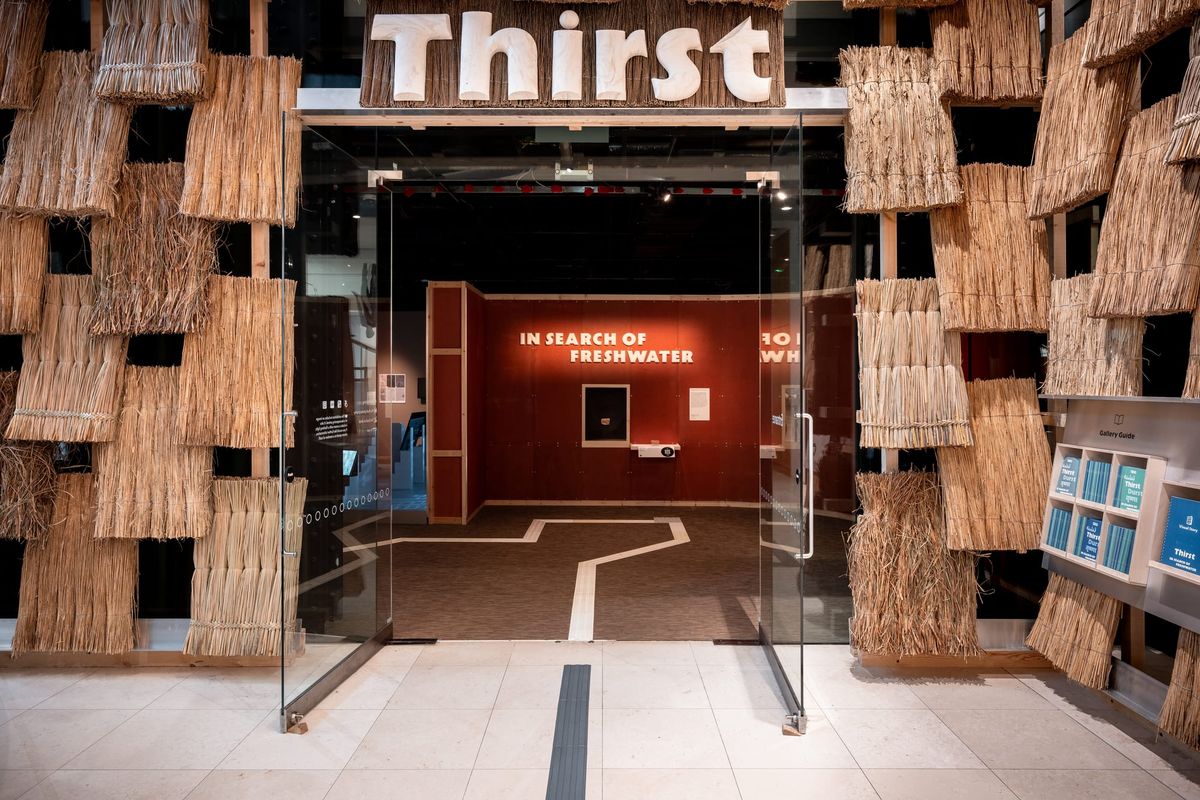
URGE Collective worked with Wellcome Collection to carry out a retrospective environmental audit of Thirst: In Search of Freshwater. The project assessed the environmental impacts of the exhibition, identified the main sources of impact, and developed practical recommendations for future exhibitions.
THIRST ran June 2025 – February 2026 over 189 days.
Thirst explored how freshwater shapes health, ecosystems, and everyday life. It highlighted the challenges of water management through time, from drought and flooding to the spread of infectious disease, as well as the established and emerging community-led responses to the global water crisis.
The exhibition combined existing works and new commissions by artists and practitioners working across different regions and disciplines. An accompanying Thirst: In Search of Freshwater book and Wonderwater café menu extend its exploration of water beyond the gallery space.
Project goals
As part of a wider review, Wellcome Collection commissioned URGE Collective to provide a retrospective environmental audit of the exhibition.
The audit had three goals:
Review the design, production, installation, operation, and decommissioning of Thirst using qualitative and quantitative evidence.
Model the exhibition’s carbon footprint and establish a baseline for future comparisons.
Review the approach used for an earlier exhibition footprint to enable fairer benchmarking over time.
Identify the activities that should be prioritised for measurement, reduction, and reporting across future exhibitions.
Explore opportunities to embed environmental thinking more consistently into exhibition design and delivery.
Review Wellcome Collection’s existing sustainability tools and identify opportunities for improvement.
URGE activities
URGE's audit combined carbon modeling, interviews with the design and delivery teams, and targeted research to identify opportunities for active improvement.
The URGE team comprising: Alexie Sommer, Bengt Cousins-Jenvey and Paul Zhu modified URGE's carbon footprinting tool to evaluate the global warming potential of Thirst and create a baseline for future comparisons. They reviewed a long list of exhibition activities, including energy, travel, materials, and transport, as well as more specialized processes like pest treatment to determine what was most important. URGE adapted Wellcome Collection's previous exhibition footprint to create a comparable 2019 baseline.
In addition to the modelling, URGE spoke with designers, contractors, and internal stakeholders to understand how decisions were made. These discussions revealed ways to make lower-impact choices easier to implement. URGE also examined specific questions related to Thirst, such as: the use of bio-based boards vs of standard MDF; and the potential role of water footprinting in exhibition assessment with confirmation from Imperial College London.
The review of bio-boards considered available impact data, manufacturer insights, barriers to adoption, and how cultural institutions can help test and normalize new / innovative materials. The findings were mapped to Wellcome Collection's design process and informed a review of their sustainability tools.
URGE findings
Approximately 50% lower total carbon footprint compared with the 2019 baseline on a like-for-like basis
Approximately 50% lower emissions per visitor on the same basis
Emissions per visitor reduced from roughly the footprint of a weekend broadsheet newspaper to that of a weekday newspaper
Priorities for exhibitions
The audit identified key areas to apply practical priorities for future exhibitions. Recommendations from URGE included focusing on exhibition-specific energy strategy improvements, more explicit travel policies and an emphasis on the reuse of structures and exhibition furniture as a default design principle from the concept stage. This includes designing around existing structures in storage, avoiding virgin where possible, specifying recycled or lower-impact materials, and asking designers and contractors to provide reuse-ready drawings and models.
Outputs and next steps
The project produced:
Impact Model covering the exhibition’s key life cycle stages and activities
Retrospective carbon footprint of Thirst
Adaptation of the carbon footprint of Smoke and Mirrors for fair comparison
Screening of the typically significant sources of impact
First-pass water footprint with academic input from Imperial College London
Focused investigation into the use of bio-boards and a comparison with MDF
Practical checklist for reducing the impacts of hot spot activities
Focus on visitor engagement as a route to positive impact
Summary of barriers and enablers from interviews with different teams
Review of the tools and opportunities to increase reuse / decrease emissions
The work provides Wellcome Collection with a clearer evidence base for evaluating future exhibitions and improving the way environmental data is collected.
Hear the Thirst team speaking about the exhibition during the MuseumNext Green Museums Summit.
Related URGE service
This project is an example of URGE Collective’s Audit approach: a post-project review that establishes an evidence base, identifies impact hotspots, and captures lessons for future work.